I Tested the Most Anticipated Motorcycle Helmet for 2026
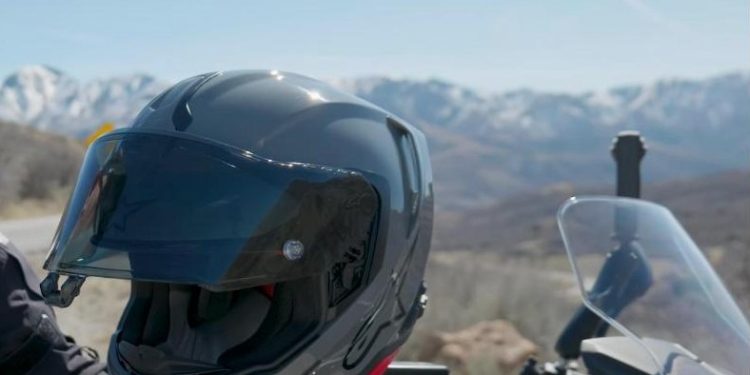
Is the Alpinestars Supertech R7 actually better than a Shoei RF-1400 or an Arai Contour-X? On paper, Alpinestars is making big promises: MotoGP DNA at a street price. But I have seen enough “game-changing” helmets come and go to walk in skeptical.
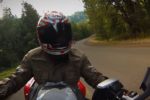
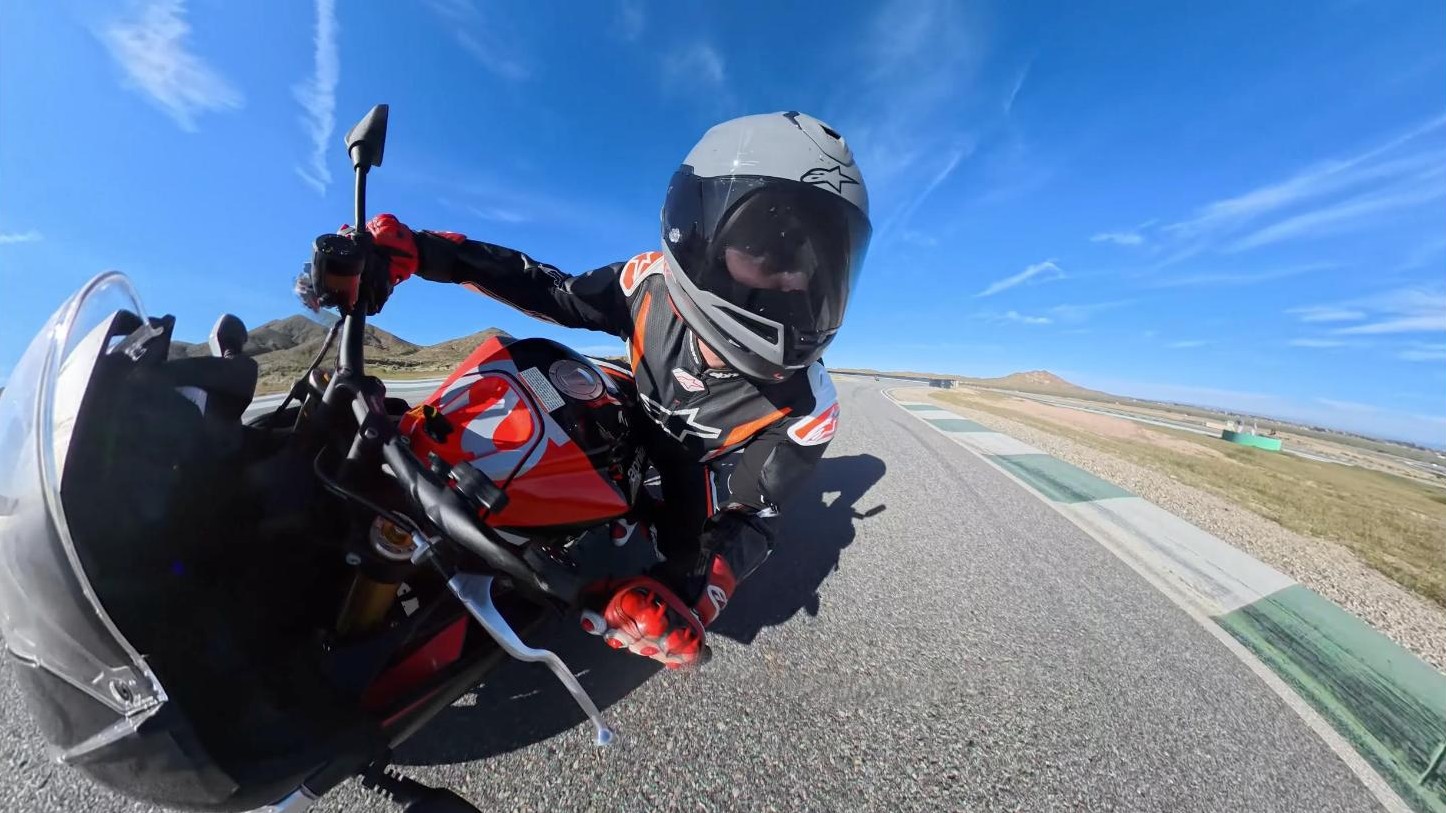
If you are shopping for a new lid right now, the R7 is probably near the top of your list, and for good reason. It looks like the $1,200, race-ready Supertech R10 that your MotoGP heroes wear, but it costs $679. Alpinestars claims it is the perfect bridge between the track and the street. So they invited me out to put it to the test: two days riding their bikes on a California racetrack and world-famous canyon roads, followed by a few weeks living with the helmet in my own backyard, in the cold and the wind, where a review actually gets honest.
The R10’s Younger Brother
It is obvious where this helmet came from. The R7 is the Supertech R10’s younger brother, and Alpinestars did not just borrow the design language, they used the flagship as a blueprint. It runs the exact same visor as the R10, which means you get the same massive field of view the pros are using. If you want the pro look without the pro-level debt, this hits the mark.
So how did they cut nearly five hundred dollars off the price? It comes down to the shell recipe. The R10 is full carbon: stiff, expensive, and featherweight. For the R7, Alpinestars went with what they call a “Safety Sandwich” of fiberglass, aramid (the Kevlar-like material used in bulletproof vests), and carbon. And you are not losing safety to get there. The R7 is ECE 22.06 certified, and if you know me, you know how much weight I put on that. I have gone so far as to order European versions of my favorite helmets just to get that ECE standard on my head, so having it here is a massive win in my book.
Why a Softer Shell Can Be Safer
We like to assume a helmet is just a hard bucket, but what is happening under the paint is the difference between a good helmet and a great one. On the cheap end you have thermoplastic, basically injection-molded plastic. It is tough and inexpensive, but it is heavy, and manufacturers have to make the shell fairly thick to pass safety tests. That extra weight on your neck all day is the “budget tax” you pay for a more affordable helmet.
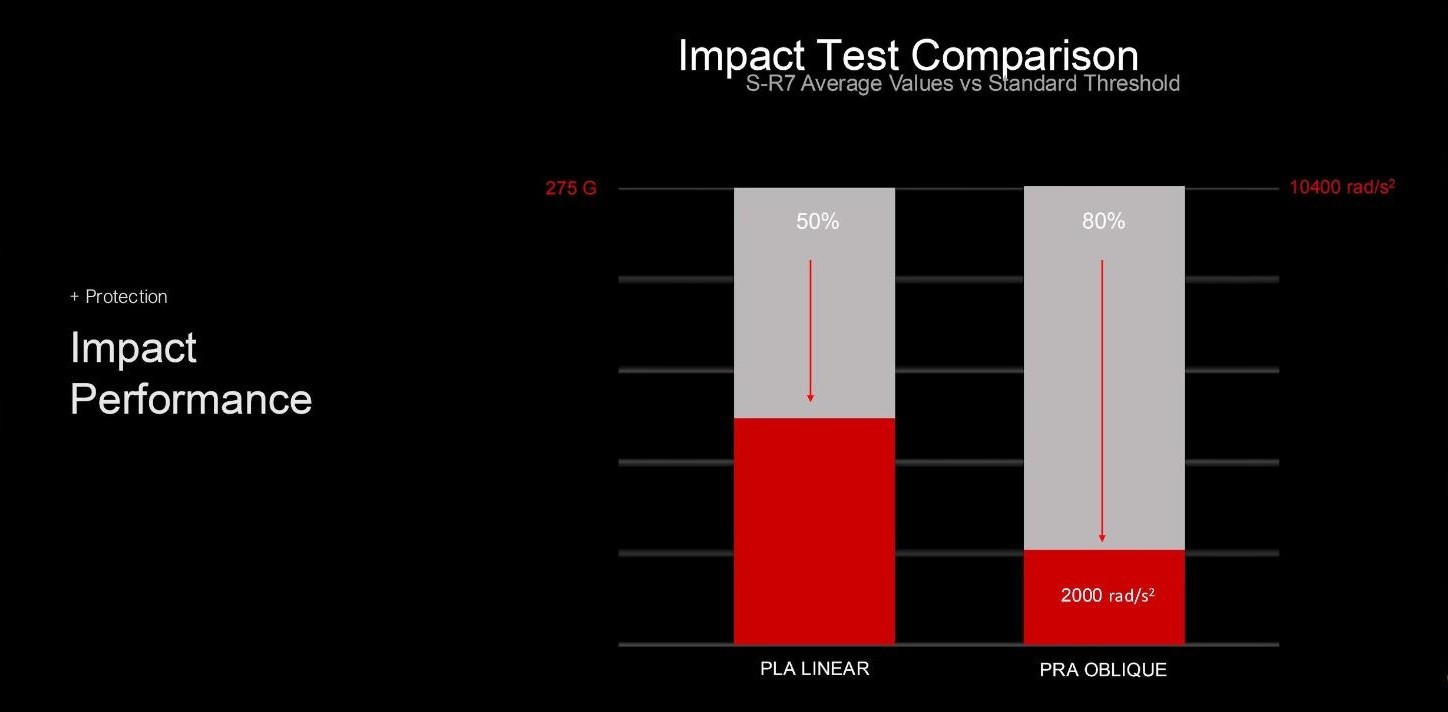
The R7 uses a multilayer composite instead: fiberglass to spread the impact, unidirectional carbon for rigidity without the weight, and aramid to make sure nothing pierces the shell. So why not go full carbon? Carbon is incredible, but it is a specialized tool for extreme physics. In a race environment where speeds are consistently in the triple digits, you want a shell built to handle those higher-energy loads. For us mere mortals traveling at street speeds, a slightly softer shell is often the better choice, because it can flex more easily on impact and start soaking up energy right away.
You can see that in the data. On a straight-on hit (linear acceleration), the R7 comes in 50 percent better than the standard threshold, because the shell is designed to flex and crush slightly. But the real magic is on the right: oblique, or rotational, acceleration, which is what happens when your helmet hits the pavement at an angle and wants to twist. There the R7 lands 80 percent below the threshold. It is not just about being hard enough to stay in one piece, it is about being soft enough to act as a cushion for your brain.
The Orange Triangles Are Not a Gimmick
Let’s talk about the bright orange triangles on the side of the shell. Some folks on our Patreon said they look like a Fisher-Price plastic gimmick, but they are actually a perfect example of racing benefiting street riders. Most of us assume a broken collarbone is just part of landing on your shoulder. Alpinestars’ data revealed a different culprit: the helmet itself. During a tumble, the lower, rigid edge of a helmet can act like a hammer, slamming straight into your collarbone.
To fix that, Alpinestars carved a dedicated collarbone recess into the shell and integrated Nucleon Plasma inserts, the same material used in the spine protector of the Tech-Air 5 Plasma airbag. It creates a soft landing zone that reduces the risk of the helmet breaking your collarbone. There is a fit bonus, too: when you pull the helmet on, those triangles cradle your lower jaw, and it makes the helmet feel genuinely secure. One caveat, they are less pliable when cold, so on a chilly morning the first pull-on takes a little more effort.
Aerodynamics: A Peace Treaty With the Atmosphere
If you have ever spent a long day on the interstate stuck behind a semi truck, you know the “bobblehead effect,” that frantic, high-frequency vibration that blurs your vision and leaves your neck feeling like it went twelve rounds with a boxer. Dirty air is a rider’s worst enemy, but the R7 seems to have negotiated a peace treaty with the atmosphere. Even in the chaotic wake of a tractor-trailer, it stayed eerily still, and it was the same story on the track, turning my head into triple-digit-speed corners.
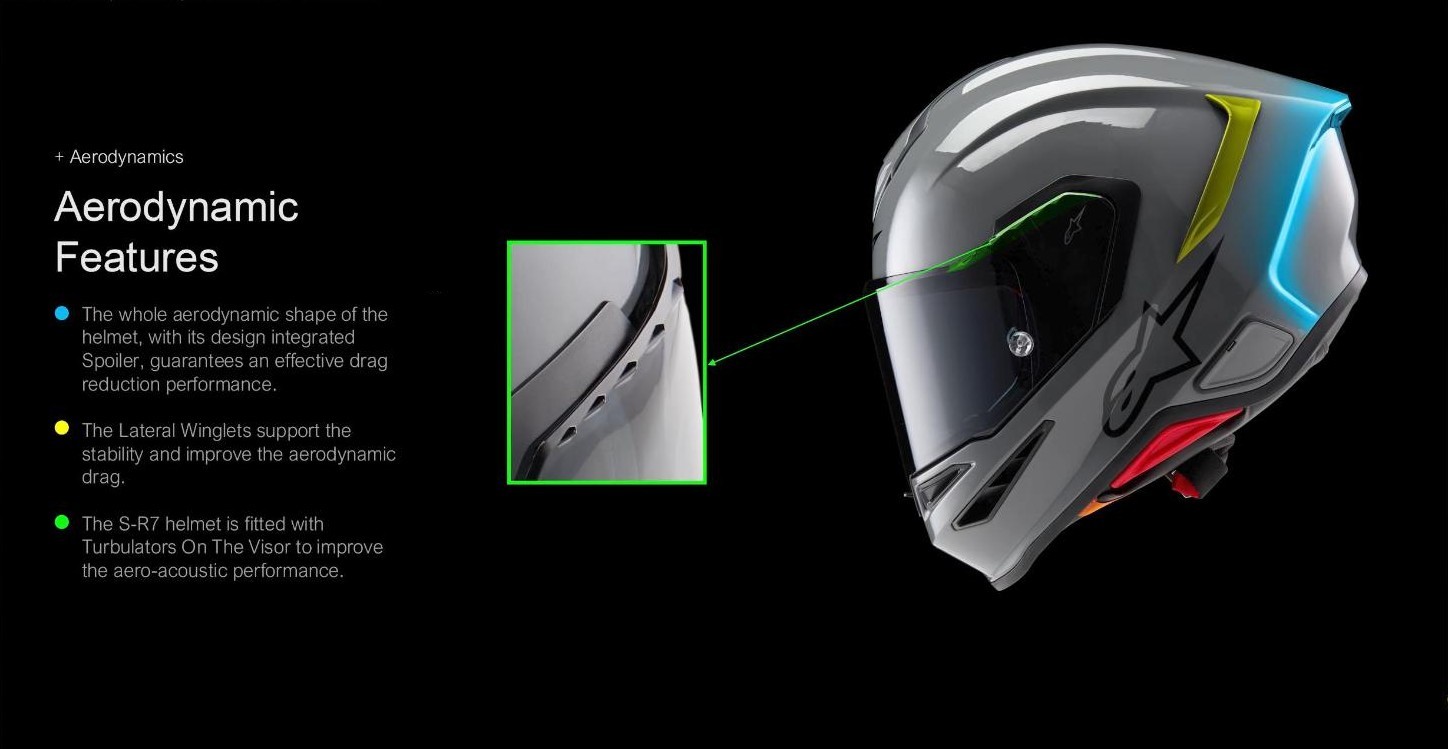
I had Brian from the podcast look at the data to figure out why. Alpinestars treats the air inside the helmet as a functional part of the aerodynamics. As you move, you create a vacuum behind your head that wants to tug the helmet around. The R7’s rear exhaust vents dump high-pressure air directly into that low-pressure void, basically closing the door on the wake and turning the helmet into a teardrop shape, like a time-trial helmet from bicycle racing. Filling that hole with the air that just cooled your head keeps the flow smooth, prevents buffeting, and keeps you cooler.
And speaking of cooling: no helmet I have ever worn moves as much air as this one. On most helmets I cannot even tell you whether the vents are open. On the R7, riding in California in the 80s I kept closing the vents because I got cold, and riding at home in the 40s I leave them shut. Then there are the little ridges on the visor that Alpinestars calls “turbulators.” They sound like a prop from an 80s sci-fi movie, but their job is to create a tiny bit of controlled chaos at the front of the helmet so the air sticks to the shell longer instead of detaching early. Less turbulence, and according to the engineers, a quieter helmet. And it is quiet. No whistles, minimal roar, one of the quietest helmets I have ridden in. Add in the lateral winglets that keep the helmet from hunting side to side, and you get a ride that is strangely calm. It is the difference between fighting the wind and just existing within it.
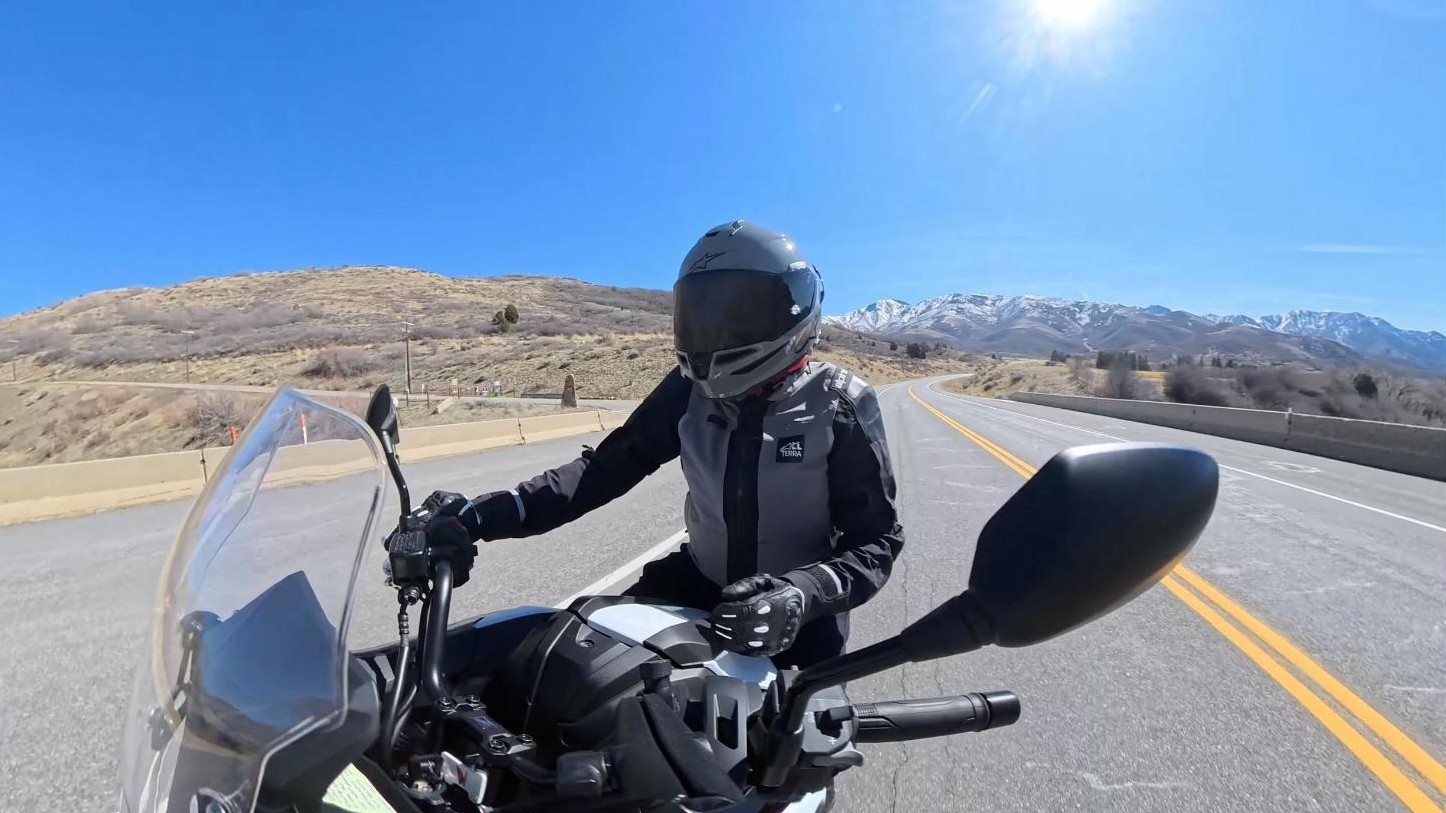
Gear I’m Wearing in This Video
The full kit I had on for this ride. These are RevZilla affiliate links: they cost you nothing extra and help keep the channel going.
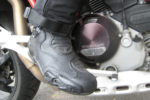
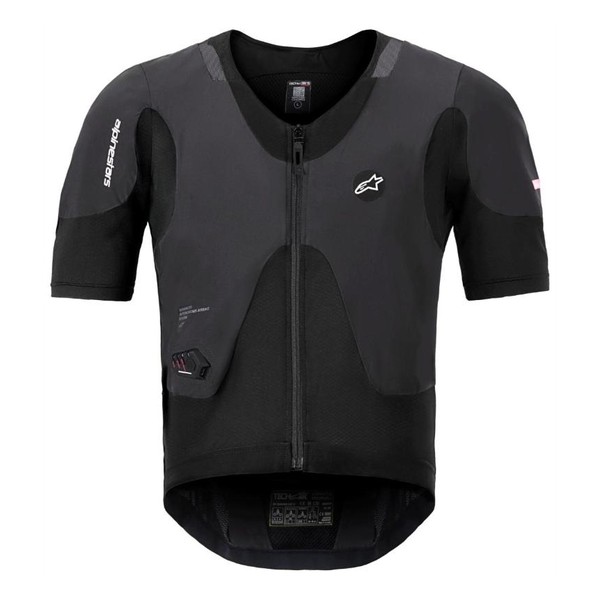
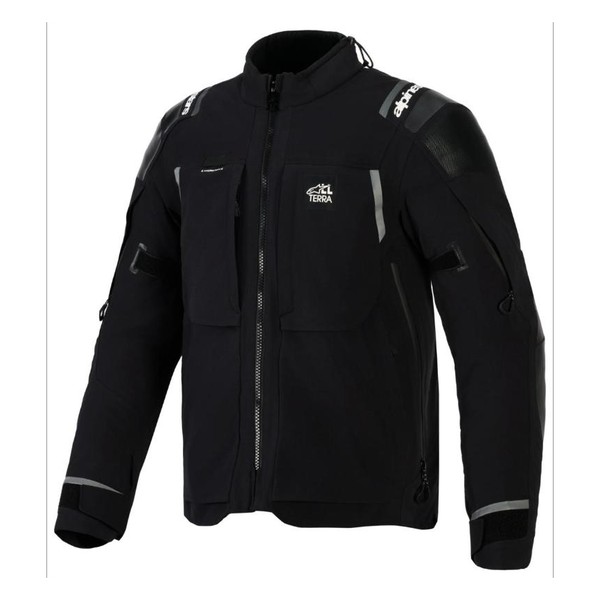
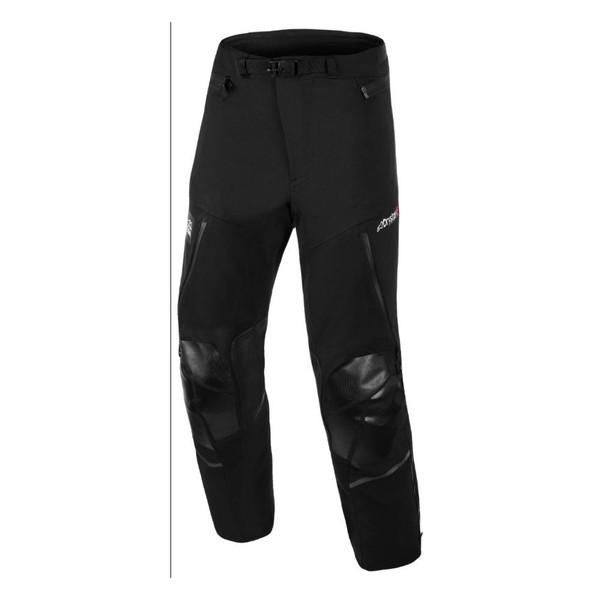
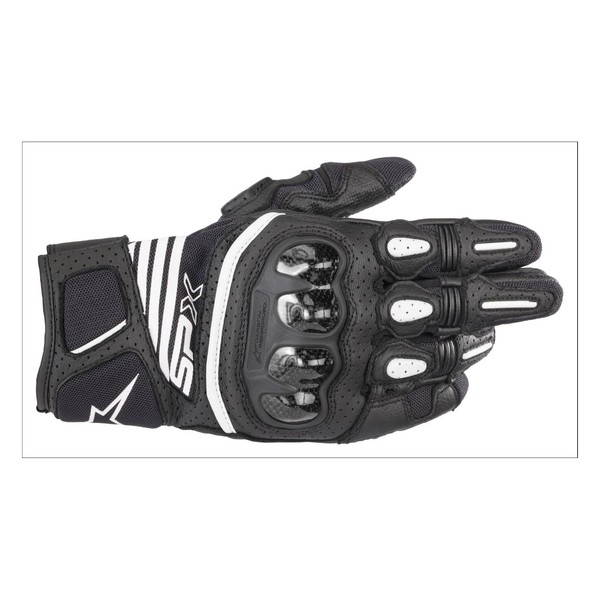
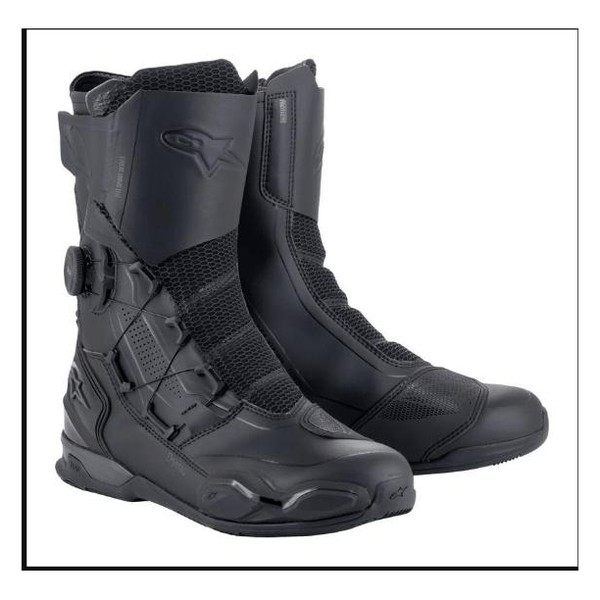
HelmetAlpinestars Supertech R7View on RevZillaAirbag VestAlpinestars Tech-Air 5 PlasmaView on RevZillaJacketAlpinestars Andes Pro Drystar XFView on RevZillaPantsAlpinestars Andes Pro Drystar XFView on RevZillaGlovesAlpinestars SP-X AirView on RevZillaBootsAlpinestars SP-X Boa DrystarView on RevZilla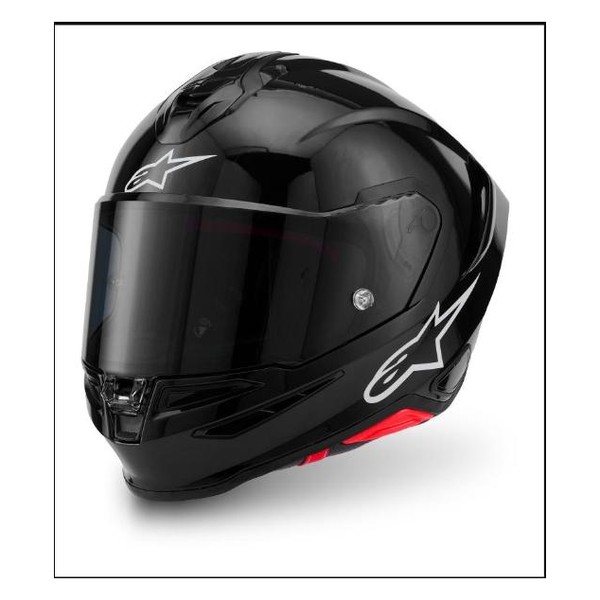
Features, Fit, and A-Connect
Let’s breeze through the rest of the spec sheet. The visor is beefy. Some reviewers have called the chin latch a little fidgety, but coming from decades on the track, I like how substantial it feels. When it clicks, it stays clicked, sealing against the gasket like a vault door, and if you are worried about it being fiddly, you will have the muscle memory down by your second gas stop. In an impact, the last thing I want is a visor deciding to go its own way.
The viewport itself is massive: 220 degrees of lateral vision and 57 degrees of vertical, borrowed straight from the R10’s racing DNA, and it is optically correct with no top-to-bottom distortion. Using the A-Head system, you dial in the fit so your eyes sit centered in the port, and when you do, the helmet’s interior practically disappears from your field of view. It takes a bit of fiddling to find your setting, but once you are dialed in, the visibility is class-leading.
Then there is A-Connect, the integrated comms system Alpinestars built with Sena: Harman Kardon speakers, Mesh 3.0, dual-core architecture, and cross-brand compatibility. It is legit good. I paired mine with my camera, and it is how I record voice-over while riding. It also made this one of the most fun press rides I have done, because we were all connected, laughing and calling out road hazards without a single “where are we going?” hand signal. Best of all, it is fully integrated: there are dedicated pockets for the wires, mic, and speakers, and the unit tucks into the back of the helmet. It is the easiest install I have ever seen. And if you are worried about the tech going obsolete, you should be replacing your lid every five years anyway. I have comms from ten years ago that still work fine. The helmet will retire before the Bluetooth does.
For fit, I am an intermediate oval head, and the R7 is great, with a soft-touch liner that is genuinely lovely and cheek pads that run slightly thicker than most brands. That last part matters to me, because I am usually buying a helmet and then immediately buying thicker cheek pads. Which brings us to the real-world price. A solid color, like this sharp grey, is $679.95. A-Connect is expected around $549.95 (not until about April 2026). Cheek pads are $129.95, and a dark smoke visor is $119.95, with more visor colors planned over the summer.
What Could Be Better
A perfect product does not exist, so here is where I nitpick. I wish it came with a dark smoke visor in the box; every helmet should include both. I love the thicker cheek pads, but you have to be mindful when taking the helmet on and off that you do not pop the snaps that hold them in place. And while I love that A-Connect is integrated, the trade-off is that the buttons are harder to find with gloves on while riding. You may or may not opt for A-Connect, and I will probably do a future video comparing it to a more traditional Cardo setup.
Would I Actually Buy One?
At the end of the day, a helmet is arguably the most important piece of gear you can own, and I take my own protection seriously. I do not mind spending real money on safety gear that works. So, the million-dollar question: would I buy one? The answer is a resounding yes. I am genuinely impressed with what Alpinestars has done here, from the way the internal venting stabilizes the aero, to the adjustable fit and anti-rotation protection of the A-Head system, to the seamless integration of A-Connect. They are bringing their A-game.
You are going to see me wearing this R7 in a lot of future videos. It comes in at a mid-tier price, but you are getting premium engineering that genuinely changes the quality of the ride. It punches well above its weight, and it has earned its spot in my gear closet. Go find some twisty pavement, and remember: smooth is fast, but seeing where you are going is even better.