The Real Price of an ECU Flash is Ten Honda Civics
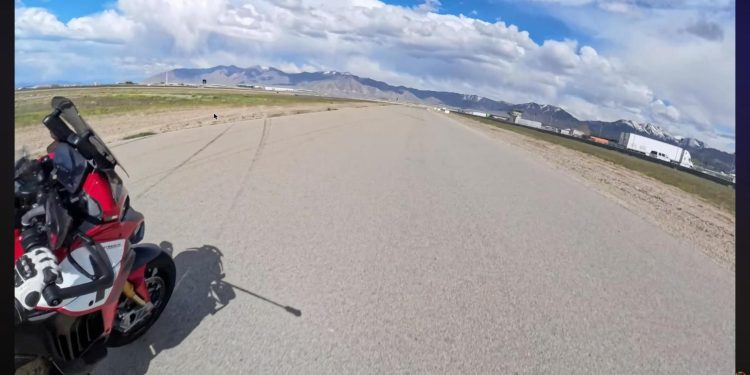
Today I’m doing something the government would probably prefer I didn’t. I’m going to flash the ECU on my Multistrada V4 to fix the fact that, in the midrange, this bike feels like a thoroughbred being forced to run a marathon while breathing through a damp cocktail straw.
Now, normally this is the part where the YouTuber starts screaming about “massive horsepower gains.” I’ll be honest: I don’t care about the power. This bike already has all the horsepowers. If I need more than that to get to Red Lodge by Thursday, I’ve made a serious error in my life choices. I’m doing this because I want a throttle that doesn’t behave like a caffeinated toddler. I want smooth, linear power delivery.
And there’s a second reason that sounds like a total contradiction: I want to see if I can improve the fuel economy.
Why Your Bike Is Strangled From the Factory
The factory tune isn’t designed for efficiency. It’s designed for “tailpipe chemistry.” To keep the catalytic converter hot and the bureaucrats happy, the ECU is constantly fighting itself — leaning the fuel out until the engine is gasping for air, then dumping gas back in to keep the pistons from melting. It’s a frantic, digital tug-of-war that leaves the bike drinking fuel like a sailor on his first shore leave, all to satisfy a man with a decibel meter.
It sounds impossible: more midrange, better throttle response, and better mileage? But if the engine isn’t fighting a restrictive brick in the exhaust and a confused computer, it can finally do its job.
The discrepancy between regions is the proof. You can walk into a European dealership and buy a Honda that makes a glorious 180 horsepower — but the moment that same bike lands on American soil, it’s been put on a restricted diet that drops it to 150. Same engine, same pistons, same valves, with the digital equivalent of a ball and chain bolted on. Our drive-by noise laws are particularly draconian, forcing manufacturers to literally kill the power in the middle of the rev range just to pass a test.
Fuel makes it worse. European fuel is a bit like a double shot of high-end espresso; American fuel is watered-down gas-station coffee. Different measurements, different additives — so that delicate factory map, calibrated for Europe, falls apart over here. Imagine trying to run American gas in Italy or Japan and you get the idea.
So today we’re telling that nervous bureaucrat living inside the ECU to take a holiday. We’re removing the catalytic converter, and we’re remapping the fueling to behave like a proper motorcycle again.
Full disclosure before we get into the grease: this is not sponsored. Nobody sent me these parts. I reached into my own pocket for the bike, the LeoVince mid-pipe, and the UpMap. I’m using my Multistrada as the test subject, but this should hold true for just about any modern bike.
The Hardware: A Brick of Sadness
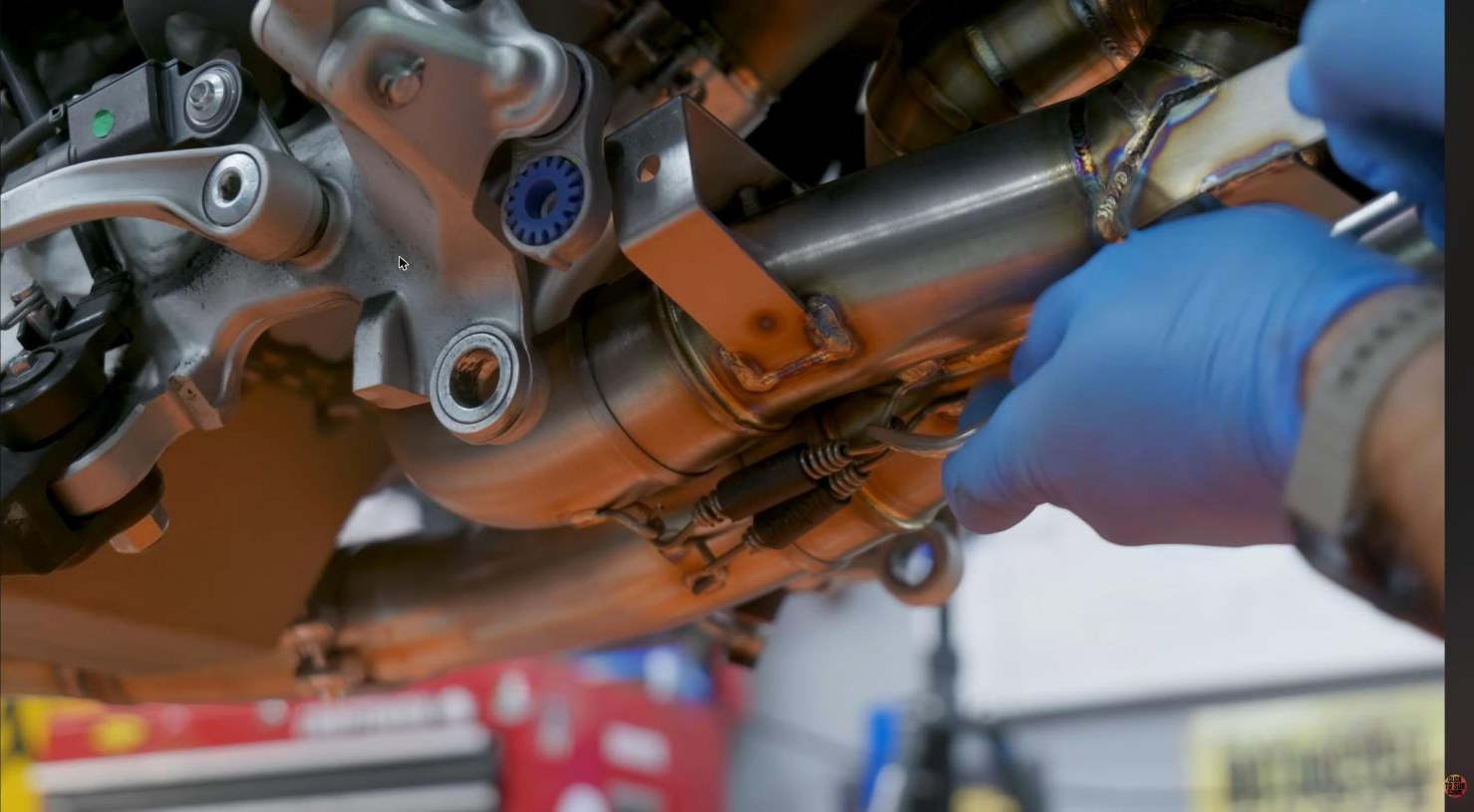
The catalytic converter is basically a giant, heavy brick of sadness stuck in the exhaust. Pulling it and dropping in the LeoVince mid-pipe is the mechanical half of the job. Two things are worth knowing before you’re under the bike.
First, wear gloves and keep your hands off the bare metal. Any oil or grease — even the natural oils from your skin — will stain the pipe the moment it heats up, effectively tattooing your fingerprints into the steel forever.
Second, resist the urge to torque anything down early. Assemble the whole system loosely first. You want enough play to wiggle everything into alignment, and only once it’s all sitting exactly where it should do you go back through and tighten it down.
The Flash: Digital Heart Surgery
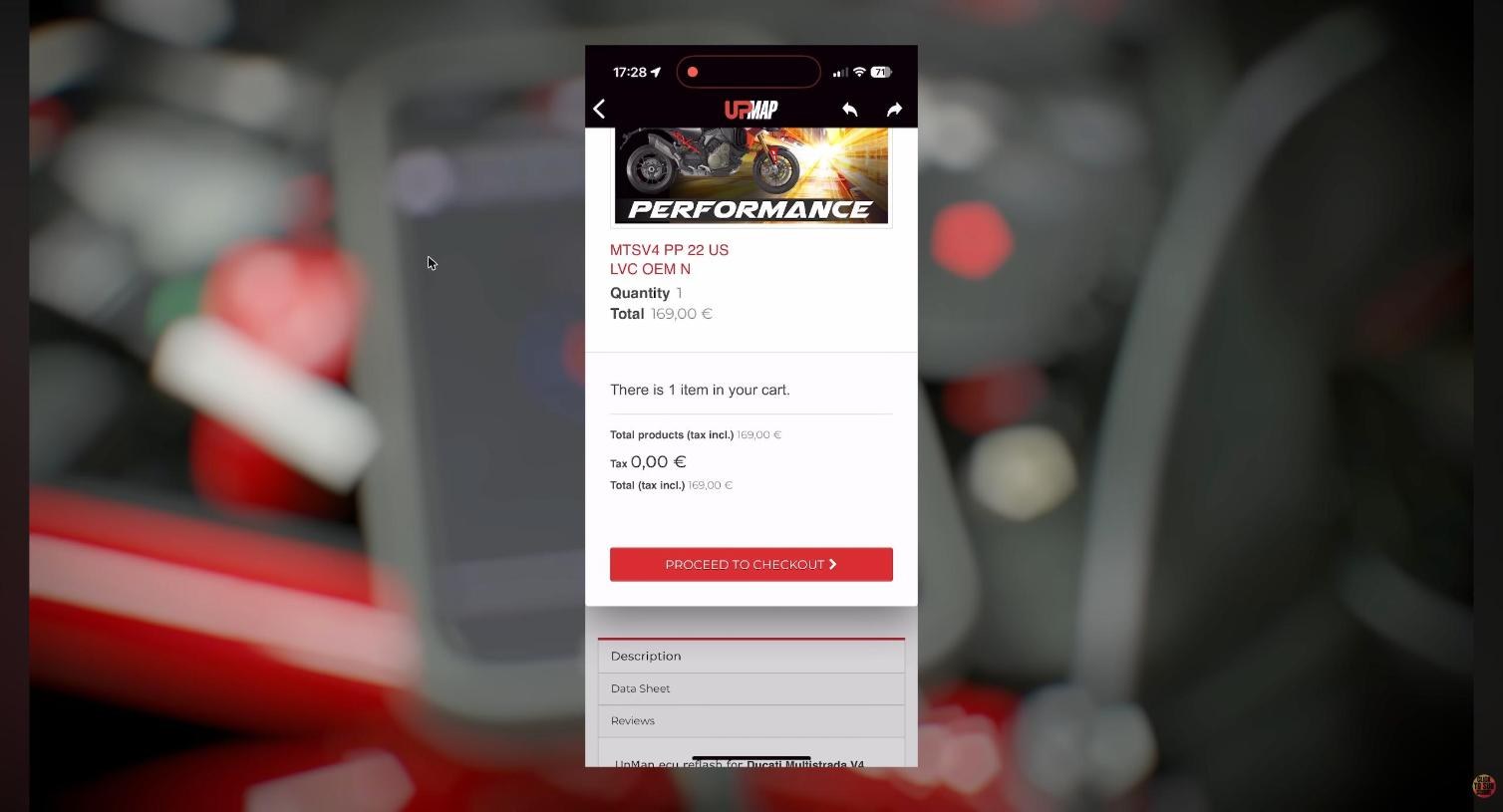
The flash intimidated me at first. You’re essentially performing digital heart surgery on a very expensive Italian machine, and the fear of “bricking” the bike feels real. In practice, the UpMap system is remarkably straightforward. You plug the T800+ into the diagnostic port under the seat, and the app handles the handshake.
Honestly, the most frustrating part was the e-commerce side of the app. You get one free map with the device — but finding the exact one for your specific exhaust, then navigating the voucher system to “buy” it for zero dollars, was easily the most confusing step of the whole project. Once the map is in your library, the rest is intuitive. As long as you don’t treat the instructions like a terms-and-conditions page — actually read every word before clicking next — the app walks you through the ignition cycles and battery checks without any drama.
The Legal Reality
Time to be the adult in the room for a minute. By removing that catalytic converter and flashing the ECU, this motorcycle is, legally speaking, no longer a street bike. In the eyes of the law it’s now a closed-course competition vehicle. The EPA and the Clean Air Act are clear: tampering with emissions equipment on a road-registered vehicle is illegal. You’re trading compliance for performance, and that’s a choice every rider has to weigh for themselves.
The Payoff: A Bike Transformed
Legal disclaimers aside, I have to tell you about the bike — because frankly, it’s a revelation.
Before this map, navigating traffic at low speed was like riding with a geriatric uncle who can’t decide which pedal is which: constant, jerky, unprovoked lunging. With the UpMap and the LeoVince mid-pipe, the fueling is — and I don’t use this word lightly — perfect. Across every map, the jerkiness is gone. The low-speed surging has evaporated.
Forget the peak horsepower number you only see for a split second at redline. The real difference is in the delivery. The torque curve has been filled right in the meat of the rev range. Between 4,000 and 8,000 rpm, the bike has gone from a nervous, highly-strung machine to a linear, predictable masterpiece. That weird midrange sag where it felt like it was holding its breath? Gone. Now, at any throttle position, it just pulls with a clean, relentless surge.
Then there’s the sound, which is, in a word, glorious. I generally don’t like loud pipes, and without the cat this bike is decidedly louder. But here’s the reality: I ride with earplugs, and at almost all speeds, from inside the helmet, I can barely tell a difference during normal cruising. Get into the top third of the rev range, though, and it sings — that spectacular, magical tone only a V4 can produce. I do wish it weren’t quite so loud, and it’s a shame LeoVince doesn’t offer a dB-killer or a smaller cat for this mid-pipe. But that V4 howl is a hell of a consolation prize.
Finally, the fuel economy — the part that still blows my mind. Before, I was lucky to squeeze 100 miles out of a tank before the fuel light started screaming. Now I’m consistently getting over 140 miles before that light comes on. That’s a massive jump in efficiency, purely from letting the engine run the way it was designed to. The only exception is the track: in full Race mode, I was draining the tank in 60 to 80 miles. Yeesh.
The Real Cost: Ten Honda Civics
Here’s where I’m honest, because the math caught me in a moral tug-of-war. On one hand, the bike is burning about 15 percent less fuel. Objectively better. On the other hand, a Euro 5 bike is only allowed to emit a tiny amount of hydrocarbons and nitrogen oxides, and by removing that cat I’m likely emitting three to five times that.
This bike only sees about 2,500 miles a year. The added economy actually drops its CO2 from roughly 1,300 pounds a year to about 970. I should have stopped there. But I kept doing math. Before the cat delete, those miles put out roughly 650 grams of pollutants — about a pound and a half. After, it’s around 2,500 grams. Over five pounds.
Put that next to a modern car and it stings: 2,500 miles on this bike is roughly ten times the localized pollution a modern Honda Civic or Toyota Camry produces in 11,000 miles. In terms of the air quality right around you, this bike is now dirtier than a fleet of ten modern cars — the tailpipe equivalent of a ’60s muscle car.
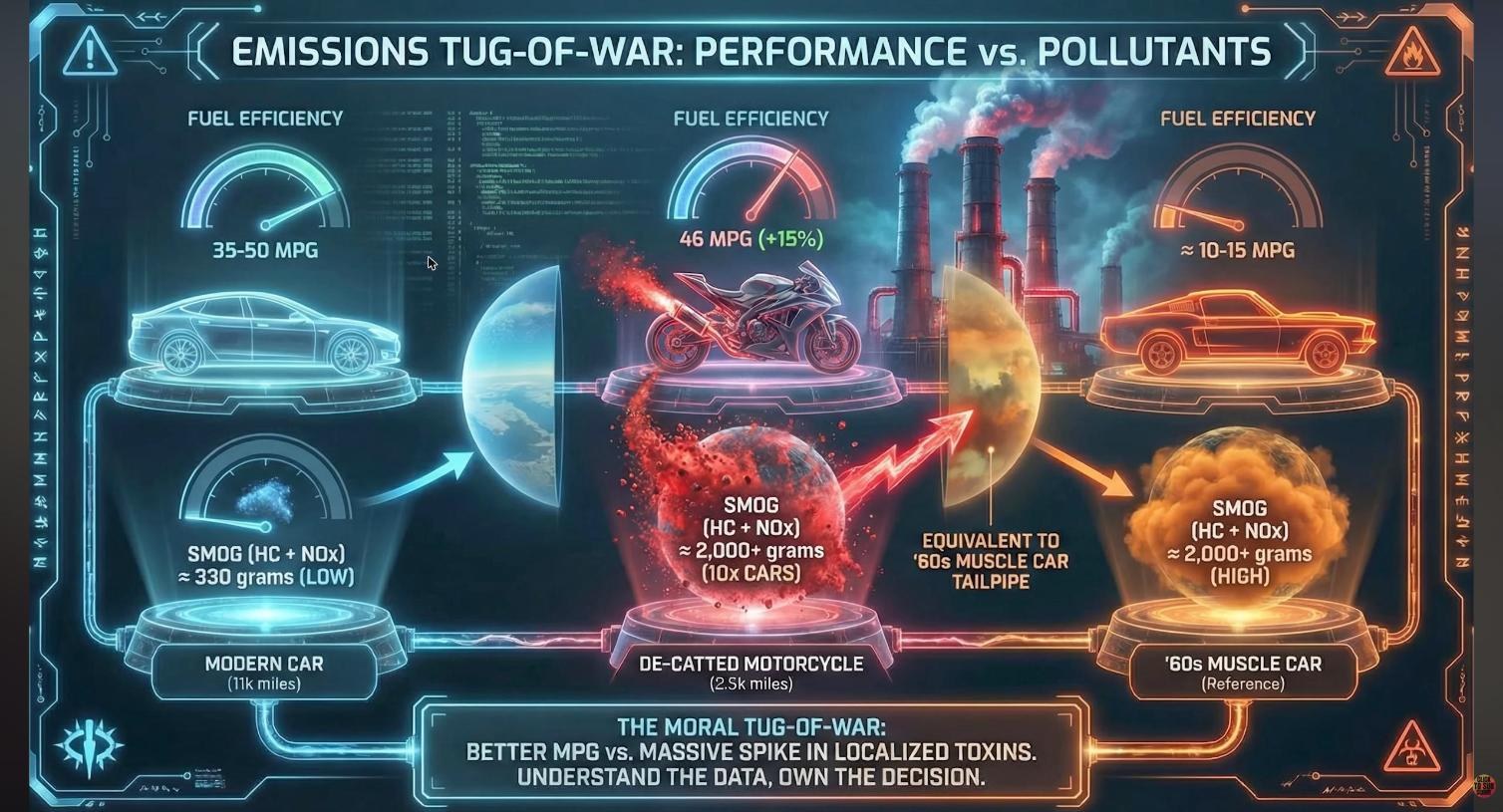
I’m not going to pretend that burning less gas makes this a green machine. It’s just the reality of the trade-off I made to get a functional motorcycle. Whether that’s a valid justification or just a way to sleep at night, I genuinely don’t know. Like anything else we do on two wheels, the goal isn’t to pretend the downside doesn’t exist — it’s to understand the data so each of us can make an informed decision.
Was It Worth It?
This was an expensive upgrade. Between the mid-pipe and the UpMap, it’s not an insignificant investment. But it has transformed the experience. We didn’t just make the bike faster — we made it right. We took a world-class machine that was being strangled by red tape and gave it its soul back.
It now performs the way I expected when I first signed the papers — the way a MotoGP-inspired Ducati V4 should. Unequivocally, it’s made the riding experience more visceral and more joyful, and I can’t deny it. The bike is less a collection of compromises now. It’s a lot closer to being a masterpiece.